GOLD-MINING, bungee jumping, jet boating, skiing and hiking aren’t the usual hallmarks of a great wine-growing region. Let alone one that many nominate as their favorite in a country brimming with worthy alternatives.
But that’s exactly the case for New Zealand’s Central Otago.
According to one major Auckland wine retailer, consumers put Central Otago at the top of their list when it comes to buying New Zealand’s favourite red wine, pinot noir.
A spokesman for Glengarry told mattsays.com the choice appeared to be driven mainly by the region’s “fame” among NZ consumers. This was reflected on the retailer’s shelves with Central Otago pinot noirs outnumbering those from any another NZ region area by a considerable margin.
Great thyme
The allure of New Zealand’s tourism capital and its consequent effect on consumer choice hasn’t escaped other wine industry figures, either.
“The thing about Central Otago is it’s an amazing place,” says Master of Wine Michael Henley. “You get off the plane in Central Otago and you smell the air and you think, ‘Jesus, this is amazing’. And you smell the wine – you think this is amazing. You’re having an amazing time and the wines tastes great. So people love Central Otago.”
Of course, it’s not just the picture-postcard panoramas of lakes and thyme-covered mountain ranges that leave an impression. Henley, who lives in the Hawkes Bay, credits the region’s viticultural pioneers and “incredible winemakers” for making a unique style of wine that resonates with consumers.
Pinot Noir is also Central Otago’s strong suit. Its 1683 hectares of pinot noir plantings dominate the region’s next biggest variety, pinot gris, by a factor of ten. That’s nothing like any of the other main NZ wine regions in each of which pinot noir plays second fiddle at best to other varieties. Even Wairarapa – home to an esteemed pocket of pinot noir in Martinborough – boasts more area under sauvignon blanc than the black grape.
Sub-regional diversity
Perhaps Central Otago’s other advantage over other NZ regions is its sub-regional diversity. While the region is universally regarded as being NZ’s only “continental” climate – or semi-so – its grab-bag of basins, valleys, terraces and glacial moraines offer a variety of different aspects and growing conditions across the area’s Martian landscapes.
Michael Henley said Central Otago pinot noirs were readily identified by their aromatic intensity. However, the area’s signature style was also evolving as it matured.
“The thing about Central Otago, which defines [the region] for me is about purity,” Henley said. “It’s like smelling the mountain air and the wild herbs that grow around it. They are pure style wines.
“But it’s changing. In the past century, Otago pinot used to be all ‘wow’ wines. They used to be wines you’d stick your nose in and just go, ‘Wow, yes, that was incredible….yes!’. And then you taste them and it’ll be packed full of flavour and that sort of Central Otago herb and things – all of those.
“But the winemakers have grown up and they’re changing. They’re starting to say, ‘Hey, you know, maybe we don’t need to be at 14 and 14½ percent alcohol. Maybe we don’t need to get as ripe. And maybe we don’t need to throw as much wood at it. Maybe we can just sort of sit back and just let this site express itself.
“So the wines are becoming a little more subdued…a little bit more elegance to them…a little less extracted. So they’re changing a little bit.”
Blind favourite
All this regional sophistication, consumer appeal and winemaking development should therefore make Central Otago the obvious region to choose when buying a NZ pinot noir.
But not according to the country’s biggest survey of NZ wine quality – the wine show system. Going by its numbers, New Zealand’s best pinot noir region is actually Marlborough. And not by a little but by a lot.
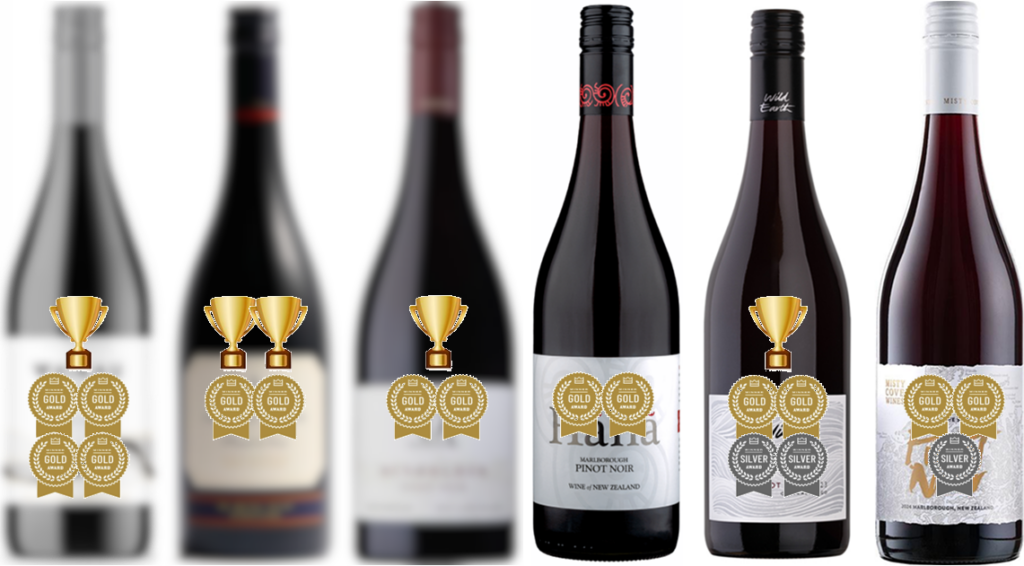
NZ wine shows assessed 420 pinot noir exhibits last year across 300 individual labels.
Although Central Otago dominated the Top 50 wines with nearly half of that tier (23), it was neither the best region, the cheapest, the best value nor provided the top-ranked wine.
Martinborough ranked as the top region by average score and provided two of the top three wines. Its otherwise small presence of only six wines in the Top 50 makes too much statistical inference beyond these observations unreliable.
But all the other accolades sat with Marlborough, which accounted for seven of the Top 10 wines, one-third of the Top 50 and took out first prize for the best wine with a label that sells for just NZD$25.
Bigger is better
Perhaps this shouldn’t surprise. Marlborough is New Zealand’s biggest wine-growing region after all. Sauvignon blanc remains its biggest variety by far with 12 times as much acreage than pinot noir. Moreover, much of the original pinot noir plantings were destined for sparkling wine production.
But more recent pinot plantings have focused on clones better suited to still wines and Marlborough’s total acreage of pinot noir is now a quarter bigger than Central Otago.
What really separates the two is price. Central Otago, which accounted for just one of the Top 10 with a $49 wine, averaged $45/bottle in the Top 50 list. That compares with Marlborough with an average $30/bottle and the cohort’s lowest median price of just $25.
Still – that’s all a lot cheaper than Glengarry’s Burgundies which it says typically retail for between $80-120 for village-level wines.
The inability of price to predict quality is a familiar theme in the wine show data across Australia and New Zealand. In the case of NZ pinot noir:
• Price does not predict score in the Top 50. Spending more buys you nothing on average.
• The best value lives at the bottom of the price ladder. The cheapest of three price buckets (less than $25) has the highest average score (94.42) and includes the highest ranked wine.
• The most expensive region – Central Otago – (average $45/bottle ranging from $18–$105) has the lowest average score of the four big regions. You pay a premium for the postcode.
• Marlborough is not just the best region by value and price (15 wines have an average price of $30), cheaper wines from within the region actually score better than expensive ones.
• Conversely, Martinborough and Waipara’s small samples are positively correlated for price and scores. Paying more does deliver higher quality in these regions.
Henley said the importance of price, value and quality depended on the experience of the consumer.
“The value-quality ratio is very subjective,” he said. “Someone who goes, ‘Hey, here’s a $50 Pinot…I don’t get that much out of that versus a $20-25 Pinot’ – that’s a very subjective thing. Now we can talk about regional diversity and regional and sub-regional nuances and things….if you are on a journey of wanting to know… a little bit more about this and really want some more detail around it, then probably the story that comes with the more expensive pinot is going to be significantly more interesting.
“The story is going to include provenance and history. It would probably include detail around the vineyard site….maybe it’s a single vineyard, maybe it’s not. I’m generalizing but it’s just going to include more information and it’s going to show, I would hope, more attention. Some people care about that – some people don’t.
“So what are they getting from an extra $25? You’re getting the brand power, I guess, in some things, but you’re getting something that maybe is a little bit more nuanced.”
Hidden charm
Michael Henley said the typical fruit expression of Marlborough pinot noirs helped elevate their profile in wine shows.
“They’re often very, very well fruited,” he said “And the good wine makers balance it … with some lovely oak that doesn’t overpower [them]. It’s definitely there to add structure and things so they’re very well clean and pure fruited wines whereas Central [Otago] is just a little bit more fragrant and perfumed.”
Henley credited Martinborough’s alluvial soils and difficult climate for the success of that region’s pinot noirs.
“They’re a little bit deeper,” he said. “They’re a little bit harder coax out of their shell. You work harder with Martinborough sometimes than you do with, say, Central Otago or Marlborough, which are very giving. And I think that’s part of the charm of Martinborough, to be honest. They’re not gonna just give it to you.”
Despite these apparent differences, Henley said most New Zealand pinot noir drinkers would struggle to separate the regions in a blind tasting.
“If I gave people a whole blind tasting of a series of wines, I don’t think people …would necessarily be able to differentiate because I just don’t think they’re interested. They’re just looking for something yummy,” he said.
“They look for something delicious, and that can come from anywhere. A lot of people do come in [to Henley’s bar] and say, ‘Oh, I want the Central Otago Pinot.’ And you’re like, well, ‘Why?’ ‘Oh, that’s because that’s what I normally like to drink.
“And so to actually ask them to articulate what it is that they are liking about Central Pinot versus Marlborough Pinot versus North Canterbury Pinot – I’m not sure if they could.”
Different strokes
Henley said NZ winemakers no longer looked to pinot noir’s ancestral home in Burgundy as an automatic reference for their wine development.
“New Zealand winemakers – as we get older – we don’t actually talk about Burgundy anymore because they are different places doing different things,” he said.
“New Zealand needs to stand on its own two feet for pinot and be an expression of pinot that is the best expression that it can be irrespective of what Burgundy’s doing.
“And one of the big comparisons you do straight away is, of course, price, irrespective of anything else. You just go, ‘Well, how much? What price are you buying Burgundy at that would be the same [quality]? What would you get from New Zealand for the same price?’
“And I can tell you – because I do this regularly and because I have a couple of Burgundies on my list – that we do a hell of a lot better quality wines than Burgundy does at the same price point.
“New Zealand pinot producers are over comparing themselves to Burgundy. They are quite happy standing on their own two feet now. And so the comparisons, wine wise, are not really there anymore.”
Maybe so. Still, Glengarry’s next biggest pinot noir selection after Central Otago is from Burgundy.
Our list of New Zealand’s Top 20 Pinot Noirs of 2025 follows:
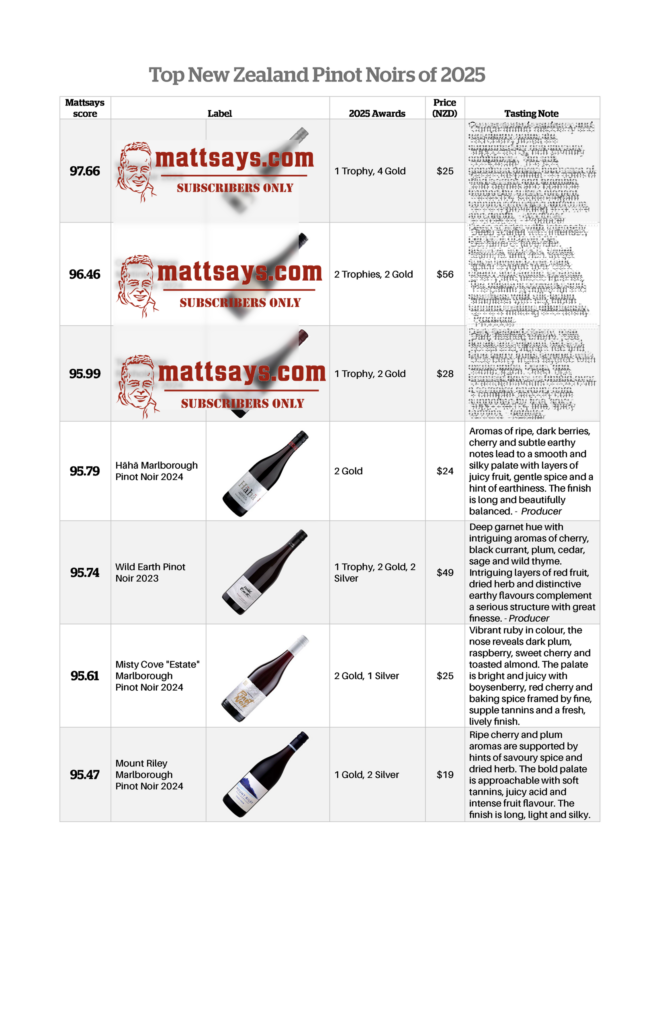
Our full list of New Zealand’s best Pinot Noirs of 2025 is available exclusively on Substack. Subscribe for free to receive regular lists of Australia and New Zealand’s best wines:
You can find all our lists of Australia’s and New Zealand’s top wines here.