FEW wines have the capacity to divide quite like chardonnay.
It’s too oaky, it’s too buttery, too acidic, not acidic enough …you name it, the grape’s detractors have strongly felt opinions that don’t seem to affect other varieties nearly as vehemently. Except sauvignon blanc, perhaps.
Chardonnay’s most ardent fans, on the other hand, reserve an enthusiasm for the wine approaching that which reformed smokers have for non-smoking spaces.
The most intense of these, of course, are “Burghounds” whose reverence of just about anything from the world’s most expensive wine acreage eclipses the possibility of acceptable substitutes made anywhere else. Had Pavlov decided to conduct his famous experiment with these people instead of drooling dogs, he might well have found the word Meursault provoked the same reaction.
All of which is rather odd when you consider that chardonnay is the most widely planted white grape in the world. There is not a major wine region in the world that does not produce it. Most produce exceptional examples that are recognised globally.
Blank sheet
Chardonnay is an adaptable variety that thrives in conditions ranging from warm and humid to cold and dry. But, most importantly, it provides pretty much a blank sheet for the stylistic designs of the winemaker.
All of chardonnay’s previously mentioned attributes apply equally to Australia as anywhere else. It is grown in every major wine region from Queensland’s Granite Belt to Western Australia’s Great Southern. In a country with the same continental landmass as the United States, that encompasses just about every climatic condition, altitude, geography and contour that nourishes chardonnay elsewhere in the world.
So you’d ordinarily expect a great Australian chardonnay to come from just about any of them. And they do.
Australian wine shows assessed 3370 chardonnay exhibits last year. The Top 100 labels – which account for just 7 per cent of all individual chardonnays seen at the shows – include examples from each of the variety’s traditional Australian strongholds: Adelaide Hills, the Yarra and Hunter Valleys, Margaret River, Beechworth, Tumbarumba and Tasmania.
Western values
But it is the westernmost of these that dominates. By a lot.
Margaret River accounted for 28 of the Top 100 chardonnays in 2025. The next biggest was the Adelaide Hills with 16. The Hunter Valley (13), Yarra Valley (11) and Tasmania (9) round out the top five.
Margaret River’s dominance was even more pronounced in the Top 20 (see our list below). The region accounted for more than half of that exclusive tier with 11 entries. The next best was the Hunter Valley with three.
These differences are not small; they are statistically significant. Margaret River is the clear outlier when it comes to chardonnay. Its performance among the Top 100 wines is significantly better than the “middle pack” of regions that follow it. Incidentally, these four are considered to be statistically indistinguishable from each other.
So what is it about Margaret River that makes its chardonnay so much better than other Australian regions?
GinGin Genie
Winemaker Julian Langworthy credits the region’s unique GinGin clone for much of Margaret River’s success.
“It’s only ever the fruit,” he told mattsays.com. “There’s no polishing turds by any means. There’s lots of great chardonnay programs around the place. But I think it’s a combination of that amazing fruit weight and amazing natural acidity. It’s a pretty cool combo.
“And then I think the third thing, for me, must be where we are. But it’s the GinGin clonal material. You get really quite powerful, structured chardonnay. There is real white tannin kind of appeal to the wines.”
Some industry authorities describe GinGin as a regional name for the popular Mendoza clone. But Langworthy, who is chief winemaker for the Fogarty Hall group, believes the local version is much closer to the American Wente clone that underpinned much of California’s plantings following Prohibition.
“It definitely has phenological similarities to Mendoza,” he said. “But there’s a lot of differences as well – especially in the fruit spectrum and the depth and density of fruit and some of the weight you get. They look ampelographically the same which is why they’re always referred to in a similar fashion. But they’re probably not that similar in terms of their heritage and where they came from.”
Acid test
Langworthy said the clone’s characteristic “hen and chicken” bunch formation, which produces small, unripe berries among the clusters of larger, ripe ones, was more pronounced and produced higher acidity than comparable Mendoza vines.
“It’s hard to compare,” he said. “GinGin’s not really grown anywhere else because of the virus load. And it is a bit of a heartbreak clonal material. It really does not crop very well. So – winemakers delight, grape growers folly.”
Langworthy said GinGin fruit outclassed all other chardonnay clones processed by his group’s wineries and comprised all of its top labels despite its drawbacks.
Still, he also agreed that the winemaker’s stamp contributed heavily to chardonnay’s final product.
“House style is huge in chardonnay and, I’d say compared to cabernet, much more pronounced for our own sort of stuff that we do,” he said. “It’s a tricky one. You can never create something amazing without amazing fruit. But you get two different winemakers, the same batch of Chardonnay and you get very different results. So I’d say [the winemaking contributes] almost 50:50 in a single instance.”
Regional differences
Despite this, Langworthy felt regional differences between Australian chardonnays were readily perceptible.
“I do particularly like Adelaide Hills and Beechworth,” he said. “Tassie’s yet to produce its best chardonnays, but they’re getting better every year.”
“Hunter was always a bit more bombastic, will have more colour and strays more into yellow fruits. Whereas the Yarra wines generally …are a bit finer, have a little less fruit detail and maybe a bit more wine making artifacts.
“Adelaide Hills is a tricky one because it’s quite diverse through some of the sites there. But I think Adelaide Hills vintage variation is huge. In good vintages, they do get a lot of fruit weight more akin to Margaret River than Yarra and they do get a really nice reduction to the wines.
“You start to run more into white stone fruit and cut nectarine in the good seasons there. And with real power and presence on the palate combined with drive.”
Good value..
Langworthy admits to being a white Burgundy “tragic” but said top-end Australian chardonnays were competitive with France’s best.
“Look, I think at $80, the Reserve Chardonnay, which is our main focus in our chardonnay program, is a bargain. With the amount of work that goes in that program, fruit yields like below three tonnes a hectare and the sort of sites and the way they’re farmed – I actually think is amazing value,” he said.
“If you can find a wine around the world in another country that offers as much character, interest, ageability and intrigue for that sort of price point – I’d be buying one. But I really don’t think they exist. You cannot get anywhere near that in France from a quality level for that price point.
“I’m not sure where that ends and there’s definitely a breaking point for sure, but I think even with things like Leeuwin Estate – it’s a big production, it’s a distinctive, wonderful wine. It’s $150 a bottle. I still think that is, in the pantheon of world wine, good value.”
..But not cheap
Value or not, three-figure chardonnays don’t dominate our Top 20 list. In fact, the average price for a Top 20 Australian chardonnay is the same as a Top 100 chardonnay at $67.
That’s still a steep climb above what most Australians spend. According to Wine Australia, domestic wine consumers pay just $12 per litre or $16 per bottle on average for still white wine . It’s also double the NZ$33 per bottle that kiwi drinkers pay for the Top 20 New Zealand chardonnays we published last week.
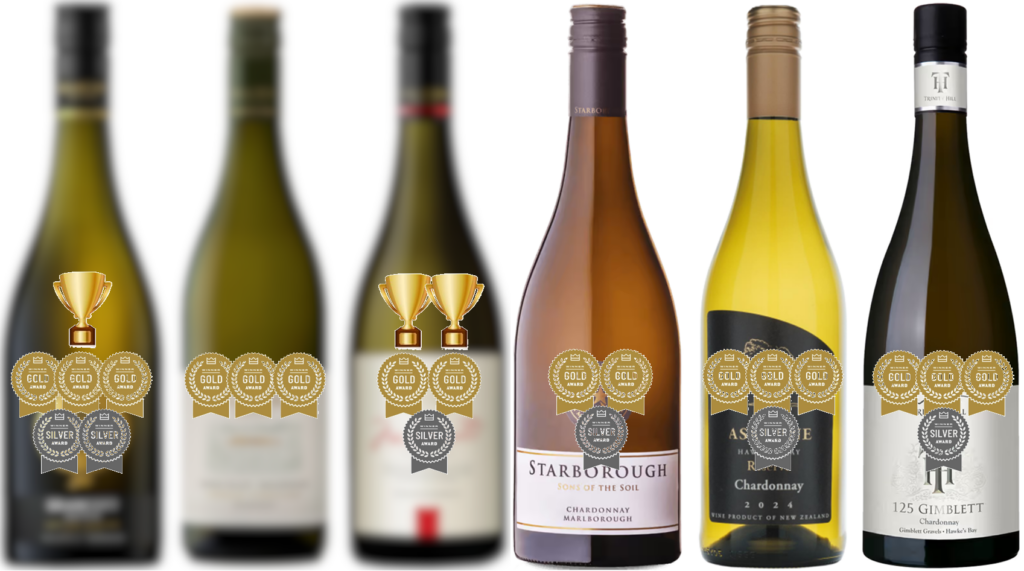
Our lists prove once again that price remains a poor indicator of wine quality. Scores were essentially flat across the four price bands observed among the Top 100 wines.
Only Tasmania showed a meaningful correlation between price and quality. However, the sample is not exactly reliable given only nine wines came from the island state.
Lovers of Yarra Valley chardonnay pay the highest price for their wines at an average of $88 but only get the fourth-best region by score. Margaret River is the best region by score but also the cheapest of the top four regions at $68.
Vintage appears to be equally unreliable as a quality indicator – even when focussing on a particular region. Vintage 2024 wines dominated last year’s shows as current vintage entries but 2023 was considered a stand-out year in the Margaret River. This is partially reflected in the wine show results with 2023 Margaret River wines winning slightly more trophies than their younger counterparts but otherwise showing much the same performance in terms of scores.
The same was true across all regions with each of the years 2022-2024 showing comparable average scores across the Top 100.
If you’re looking for any one indicator for wine quality, it might be this: seven of the Top 20 Australian chardonnays came from two winemakers last year. They work for the same company.
Our list of Australia’s Top Chardonnays of 2025 appears below:
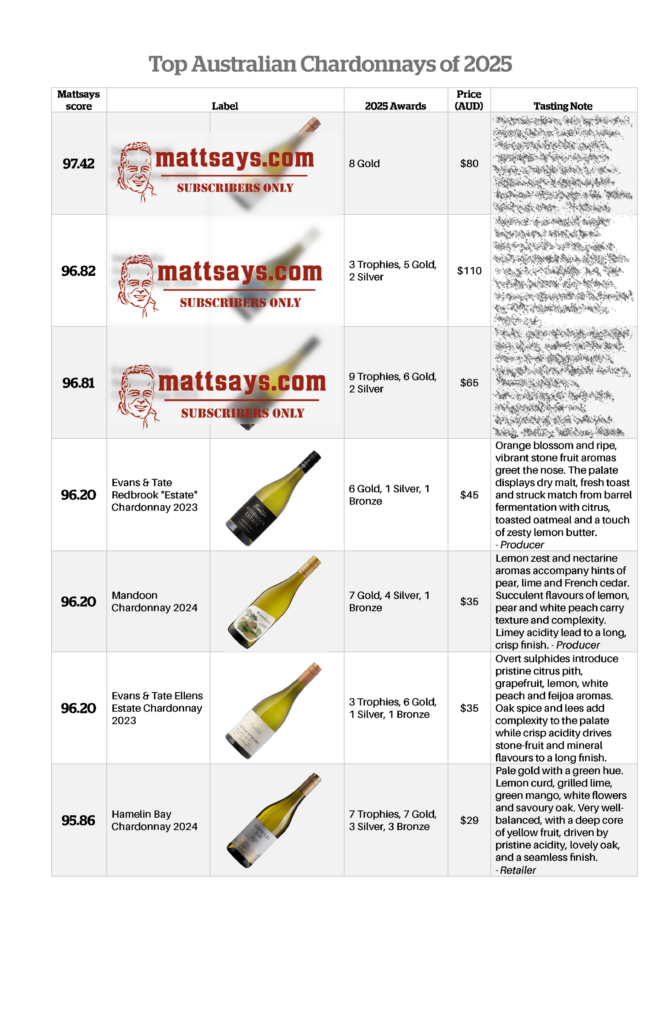
The full list of Australia’s Top Chardonnays of 2025 can be found here