TASMANIA has been Australia’s red-haired stepchild since about forever.
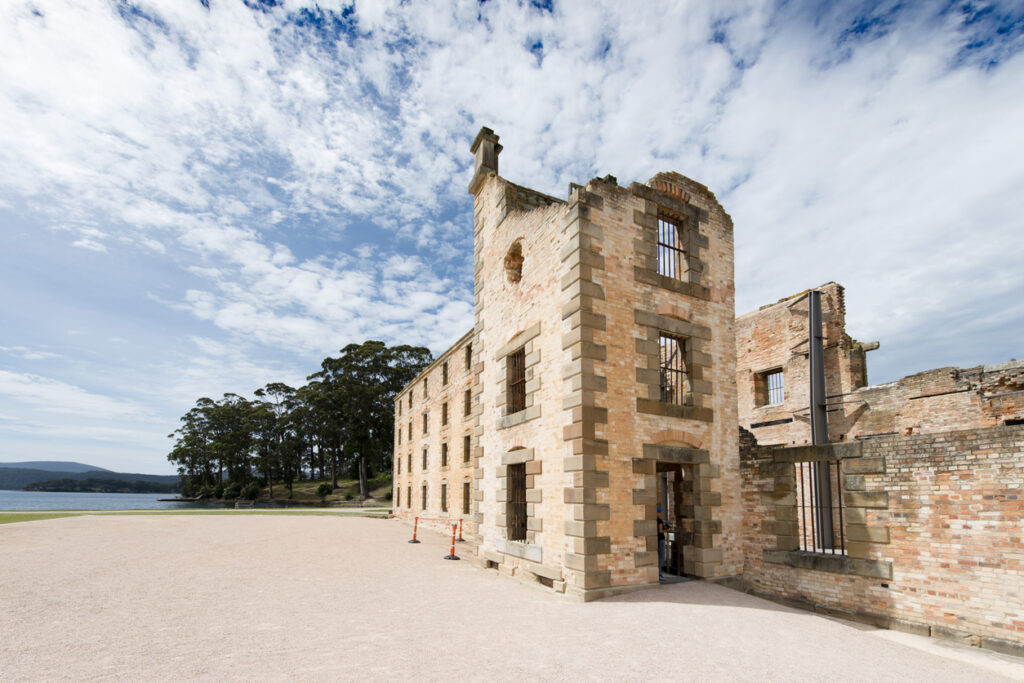
Butt of mainlanders’ jokes, derided by economists as a “mendicant state”, accused of Aboriginal genocide and used by colonists as a dumping ground for convicts, Tasmania hasn’t been able to take a trick since Abel Tasman spotted the island in 1772. The decline of Tasmania’s pipfruit industry has even meant the state losing claim to its long-standing “Apple Isle” slogan.
So stealing the mainland’s crown as the best producer of Australia’s most expensive wine variety must provide more than the usual sense of satisfaction.
Pinot noir costs Australians more than any other variety. Its average price of $17.46 per bottle is 14 per cent higher than the next dearest – pinot gris – and 26 per cent higher than Australia’s most famous variety – shiraz – according to Wine Australia.
It doesn’t stop there, either. Tasmania has become synonymous with the production of Australia’s best sparkling wines. That’s one of the only two wine categories to show any growth in 2023. It was also the producer of the most highly scored chardonnay at Australian wine shows in 2025. Tolpuddle’s 2024 Coal River vineyard chardonnay attended only one wine show last year. But it walked away from the Royal Melbourne Wine Awards with a near-perfect score juggling no fewer than five trophies.
Game changer
There is clearly a lot to love about Tasmanian wine. But it is in pinot noir that the island state thoroughly dominates its mainland competitors.
Australian wine shows assessed more than 2000 pinot noir exhibits last year across nearly 900 individual labels. Exhibitors came from the length and breadth of Australia as winemakers competed for the honour of producing the best example of maybe the industry’s most prestigious variety.
But they didn’t stand a chance if they didn’t come from Tasmania.
Of the top 50 pinot noirs ranked by us from last year’s wine shows, nearly half came from that state. More significantly, every one of Australia’s top 10 pinot noirs came from Tasmania except one. As if to prove the point, a Tasmanian pinot noir also lifted Australia’s most prestigious wine show prize – the Royal Melbourne Wine Awards’ Jimmy Watson Memorial Trophy for the Best Young Red.
None of this comes as a surprise to one senior winemaker and wine show judge.
Tom Carson, general manager and chief winemaker for Yabby Lake, makes pinot noir in both Tasmania and Victoria’s Mornington Peninsula. He said the appearance of Tasmanian pinot noirs in wine shows 15 years ago was a game changer.
“I said sort of offhand to someone back then, ‘Nobody’s going to win a pinot noir trophy outside of Tassie again’,” he told mattsays. “Those wines from Tassie – particularly if you get down south….Coal River, Tamar…. they just have incredible colour and power and presence when they’re young. And in the show environment, certainly judging young wines, colour catches the eyes of the judges quite easily. And then you’ve got that concentration of fruit and depth and power that rides along with it. It’s a bit of a battle to get judges to look past the captivating intensity of these wines and try and see what the other wines are offering as well.”
Profound pinot
Carson, who was also the chief judge for the Australian Pinot Challenge last year, put the Tasmanian wines’ dominance down to the island’s climate and latitude.
“The climate – if you go down to Coal River – is a very dry region. It’s quite continental,” he said. “It’s got longer sunshine hours. It doesn’t rain much there. There’s not a lot of cloud. You get a lot of UV there similar to parts of New Zealand in the South Island that also make quite deeply colored and profound pinots. I think that was really something we hadn’t really seen on the Australian mainland was that type of climate that far south in Australia and what it could do. So it was a new aspect to what Australian pinot can be.”
Carson said the regional differences could also be discerned even within Tasmania.
“The colour and tannin out of the Coal River and the surrounds is something unique,” he said. “Up north the wines are a little more red fruited and fragrant in a very general sense and a bit more structured and darker down in that southern section of Tassie. So there is quite a difference I feel when from what I’ve tasted.”
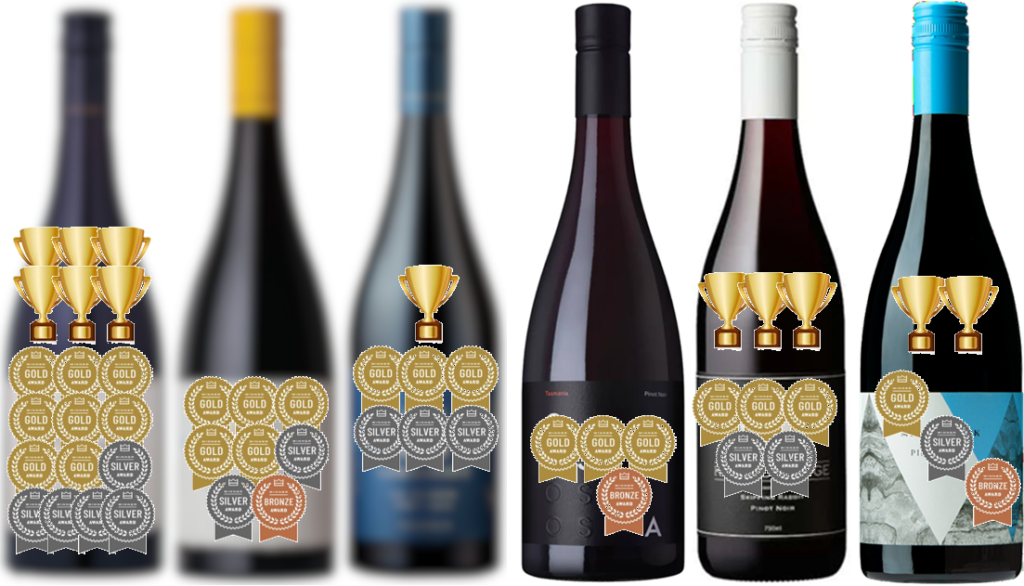
The next best regions outside of Tasmania according to the wine show data are the Yarra Valley and Mornington Peninsula although both play second fiddle to a group of sundry Victorian regions that includes Sunbury, Macedon Ranges and Gippsland.
Carson said the climate variation between the Mornington Peninsula and Tasmania brought different winemaking challenges.
“I think we use a bit more whole bunch on the Mornington when the conditions are right,” he said. “And we’re treading a little bit carefully with that down in Tassie. Getting the ripeness just right is one of the key things to making really good wine and having the patience to pick it on the right day. Down in Tasmania, we were picking in very late April this year in the Coal River and we’d finished pinot on the Mornington weeks before that. So getting the vines and the fruit to exactly where they should be is certainly a challenge. And probably things happen a bit quicker up here on the Mornington than down there.”

Carson said the main Australian pinot noir regions each offered distinctive styles.
“We do lots of blind tastings and the number of times we mess things up between regions and countries is astounding,” he said. “So it’s never easy tasting these things blind but I think if you’ve got very typical examples of them, you could pick the difference.
“Yarra pinots are quite distinct when they’re made well. They’re quite red fruited and they’ve got lovely, silky tannins. When they’re young, they’re just beautifully well balanced.
“Mornington sometimes has a little bit more colour, a little bit more tannin and extract can be a little bit darker and more broody when they’re young and from down the hill. Up the hill, they’re more fragrant and lighter framed. Gippsland is maybe a little bit spicier.”
Burgundy still king
Carson acknowledged that the Adelaide Hills, once a noted producer of the variety, was no longer a reliable producer of its best examples.
“When you compare the Adelaide Hills pinot noirs to the cooler parts of Victoria and Tassie, they probably lack some complexity,” he said. “Some years there it does seem like parts of it are a little bit warm. I think the southern regions in Victoria and Tasmania are producing higher quality pinots than the Adelaide Hills at this point.”
Despite the improvement in Australian pinot noir, Carson believed the local product had not yet achieved the heights of red Burgundy.
“I’ve tasted a lot of Burgundy and I would say with chardonnay we can get eerily close to [their] very best wines,” he said. “But with pinot noir, I think the very top grand crus from the best producers are in a different stratosphere to what we are producing here.
“To appreciate the very best of [red] Burgundy, you have to taste them with some age. That’s when they really show their true quality. And we just don’t have the longevity yet in Australian pinot. To make wines that continue to improve at the very, very top level for 20, 30, 40, 50 years from a good vintage and from the right producer…we don’t make anything that is comparable to that. Those wines at age, from great vintages and great producers are just utterly captivating wines. They’re hauntingly fine and complex and just unbelievably detailed and delicious. I don’t think we get anywhere near that and I’m talking at the absolute top of the top.”
Carson thought the gap was partly explained by the micro-farming scale at which top Burgundy has been grown over a long period.
“Site selection is key,” he said. “An analogy I like is we know the terroir of pinot noir like we can spot the MCG and say, ‘That spot’s pretty good’. In Burgundy, they know every seat.
“And that’s sort of the difference. I’m staring out the window at Yabby Lake. We’ve got a vineyard here. All the land around us is no vineyard. I don’t know whether the best site is just over the hill or 10 meters over the fence into the neighbour’s place because the soil’s slightly different, the slope’s just right and everything’s just perfect. And it’s going to make better wine from that spot. I don’t know that because there’s no vines there. Whereas in Burgundy, you can look everywhere and they’ve got hundreds and hundreds of years of farming the same place. It’s all down to the potential of the site. And that’s what Burgundy is a lesson in.”
Region trumps price
As with other varieties, price offers no reliable guide to quality when it comes to Australian pinot noir. The correlation between the two variables was flat to slightly negative across the Top 50 – which means that paying more generally buys you less quality – and the price band with the best average score was the cheapest of the four (<$40).
Yarra Valley was the most expensive of the major regions to appear in the Top 50 even though its best performer ranked only 13th. The region ranked third overall by score. Interestingly, this pattern of high prices and middling performance mirrored Yarra Valley’s performance in chardonnay.
Tasmanian pinot noirs were the second-most expensive but that was a better reflection of a region’s importance as the primary determinant of quality instead of price. It was also potentially a reflection of the cost of Tasmanian pinot noir grapes. At $3990/tonne, they were Australia’s second dearest wine grapes in 2025 although it’s hard to know whether that’s cause or effect given the potential demand for them by mainland buyers. Tasmania’s premium compares with $1391 for Victorian pinot noir and $2148 for Western Australian pinot noir. It’s also a hefty margin over Barossa shiraz which attracts just $1938/tonne.
Australia’s most expensive wine grapes? Tasmanian chardonnay.
Our list of Australia’s top pinot noirs of 2025 follows:
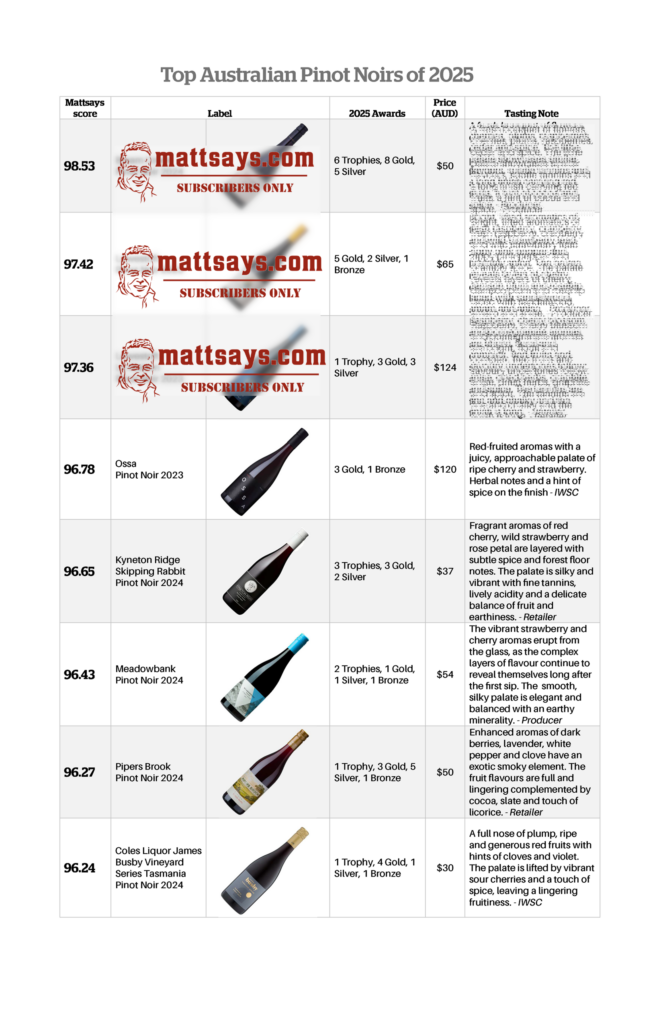
Our full list of Australia’s best Pinot Noirs of 2025 is available exclusively on Substack. Subscribe for free to receive regular lists of Australia and New Zealand’s best wines:
You can find all our lists of Australia’s and New Zealand’s top wines here.