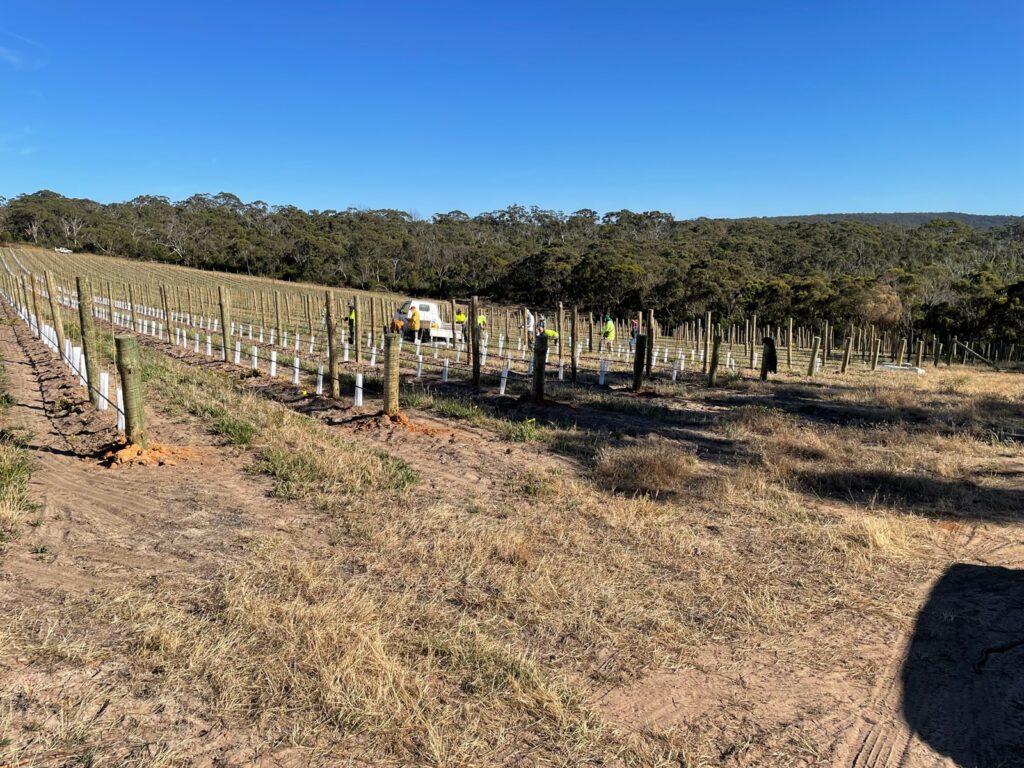
DISOBEYING one’s parents is a rite of passage for many. But defying a parent of a five-generation dynasty whose retribution is threatened from the grave – that takes determination.
Luckily for Andrew “Ox” Hardy, history is more likely to favour him than his father who issued the stern warning to never plant grenache on his historic Upper Tintara vineyard.
Andrew Hardy, now running his own eponymous label, said the decision to plant grenache followed a decline in fortunes for the original riesling vines that preceded them.
Forbidden fruit
“We persevered with the riesling until about 2008 or 9 and then Dad and I just made a decision to rip it out,” he said. “It just wasn’t viable anymore and we were getting almost nothing for the fruit. I left the block vacant or I used to just put hay crops in there…until 2020 when I decided to plant grenache.
“Dad forbid me – strictly forbade me – to sell any grenache. He said he’d rise up out of the grave and nail me if I did. Anyway, I’ve done it and I’m still alive so he hasn’t got me.”
Hardy said his father’s objection to grenache arose from its perception as an inferior variety compared with the Bordeaux varieties that were more in vogue.
“He graduated from Roseworthy in 1949 and they all came out of Roseworthy wanting to make – like all young wine students – Burgundy and Bordeaux,” he said. “And Grenache was [grown] for tawny port back then.
“And a lot of the young winemakers just thought, ‘We don’t want to make bloody tawny port – we want to make table wine’. And grenache – because it does tend to crop quite heavily if you’re not strict about fruit thinning – it can make wishy washy wine.
“They looked at the great reds of the world and they probably thought, ‘Well, grenache isn’t going to do the job. Whereas they looked at Bordeaux and Burgundy… really – probably Bordeaux back then – and said, ‘You know, red wine’s got to be big and rich and bold and black and lots of tannin and grenache doesn’t really fit that bill’. I just think it was a bit of a bias they had coming out of Roseworthy, looking at the wines of the world.”
Unlikely saviour
The resurrection of grenache has been a bright spot in an industry otherwise beset by decline. Although just a tiny percentage of Australia’s red wine crush at 16,000 tonnes, current volumes are just 13 per cent lower than their peak in 2017. That compares with all reds which are 27 per cent lower than their peak in 2020.
However, crush volumes don’t tell the whole story. One particularly compelling statistic illustrating grenache’s renaissance is the number of exhibits for the variety at Australian wine shows. Despite a decline in total wine show exhibits from a peak of 41,000 in 2017 to about 31,500 in 2025 (-23 percent), grenache exhibits have nearly doubled over the same period.
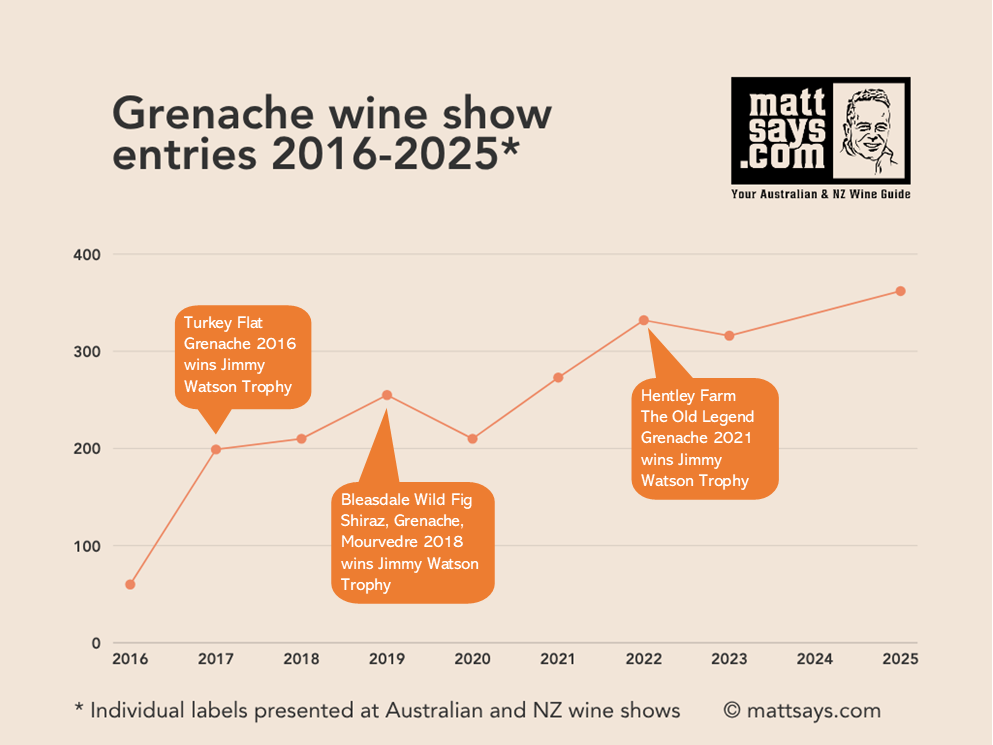
Grenache’s tipping point coincides with the variety’s inaugural receipt of possibly Australia’s best-known wine award – the Jimmy Watson Memorial Trophy. The trophy is awarded by the Melbourne Royal Wine Awards committee to the show’s best young red and received more attention than usual in 2017 when it was won by a Barossa grenache.
Prior to this date, the award had been largely confined to shiraz, cabernet sauvignon and their blends. Pinot noir was the first to break this pattern in 2013 but grenache has appeared three times since then in varietal or blended form.
Andrew Hardy said grenache’s lighter style suited modern tastes.
“I think one of the reasons why it’s become so popular, is that they (grenache) are much more drinkable,” he said. “We’re not trying to make dry red, and I think that was the problem in the old days. The old winemakers like Dad and all his cohort were making dry red, as opposed to saying, ‘We’re making grenache.’
“They were making grenache like they made shiraz and cabernet and you don’t want to do that. Grenache’s got its own peculiarities. It’s more gentle. It is a bit like pinot.”
Good value
Another part of its appeal is the price of grenache. The variety’s resuscitation has vaulted the fruit’s price to the top of the ladder in Australia. At $1188/tonne on average last season, grenache fetched 83 per cent more than the average price of all red grapes. It was a bit more than that when compared with shiraz – Australia’s most popular variety. The only major red variety to command a higher price is pinot noir at $1328/tonne.
Despite this, grenache receives significantly lower shelf prices than pinot noir that aren’t fully explained by fruit prices. Our exclusive analysis of Australia’s top 50 grenache and pinot noir as ranked by wine show results shows the Rhone variety is much better value than its Burgundian competitor. Half of the Top 50 grenache labels we ranked were $35 or under while half of the pinot noir labels were $65 or more. Median scores for the two varieties, on the other hand, were nearly inseparable.
“Most grenaches are sort of relatively affordable still,” said Andrew Hardy. “And I think that’s one of the things that appeals. They’re reasonably priced and they’ve got the delicacy and structure of pinot.”
Hardy said winemakers were continuing to move grenache towards pinot’s lighter style.
This observation appeared to be borne out by the wine show results. McLaren Vale, which tends to produce lighter wines from sandy soils, dominated 2025’s best grenache list with 30 of the Top 50. That was more than double the number from second-best region Barossa which produces fuller wines from clay loams.
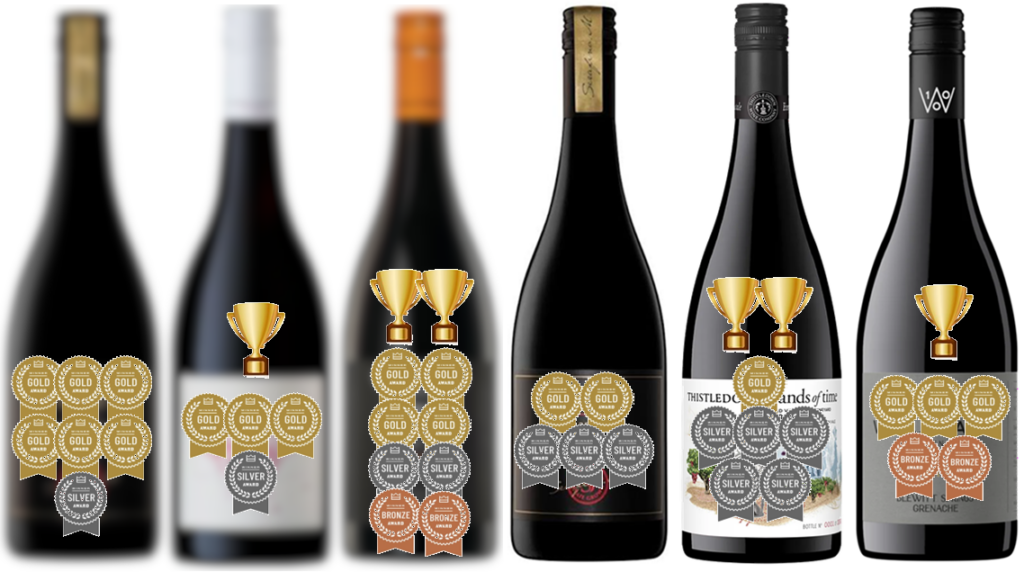
However a closer look shows Barossa labels were much more likely to win trophies than their southern competitors. It is also notable that the two varietal grenache labels to have won Jimmy Watson trophies are both from the Barossa.
This preference for fuller styles mirrors the results for pinot noir. Our analysis shows Tasmanian pinot noirs – considered more muscular than mainland labels – also achieve higher trophy win rates than their northern competitors.
Hardy said grenache presented its biggest difficulties in the vineyard. A high-yielding, thin-skinned variety, grenache required regular fruit thinning and a careful eye on botrytis development.
This was helped by Hardy’s decision to overturn another traditional approach and train his new grenache vines on trellises. South Australian grenache has historically been grown on bush vines – some of which are among the oldest in the world.
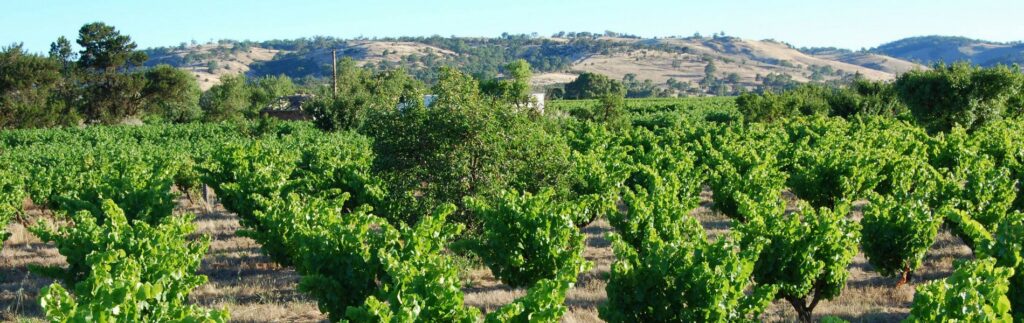
“I had a very long chat to Chester (Osborne of d’Arenberg winery) about bush vines and he said, ‘Why would you do that unless you’ve already got them? If you could put a trellis up, why would you do bush vines?’
“Grenache has great big heavy bunches so the danger of bush vines is the fruit’s going to actually be on the ground. I think it just makes it that much harder to manage… managing bush vines is just hell.”
Hardy said his new vines, which were planted from two heritage Penfolds’ clones, were already showing promise.
“In the old days, we’d say you wouldn’t get true vine maturity ‘til about seven years old,” he said. “I think the rule still stands. Old vines are always going to be better especially on the palate than young vines. Traditionally, younger vine material is often very aromatic but perhaps lacks body.
“But we thinned three times this year. We shoot thinned and then fruit thinned twice to get the crop down because they are younger vines and that really worked. If you get the crop right and the site’s correct and everything else is even, I think the gap’s probably narrowing.
“So I’m pretty excited, actually. I just didn’t expect we’d see the quality we have already.”
Thanks for reading mattsays.com! This post is public so feel free to share it.

Hardy said shiraz remained his biggest variety but predicted a bright future for grenache. He said its production was dominated by a large number of small producers each taking different approaches to the grape.
“It’s the exploration [phase] now that we’ve done with cabernet, shiraz and most other varieties,” he said. “Grenache is sort of the new kid on the block – even though it’s been around forever. We see people trying it with the Ox Grenache in tastings and they go, ‘Wow’…it blows them away. They haven’t had grenache before, so I think that’s exciting.
“I don’t know whether it’s easier to sell or whether it’s easier to drink than things like nero d’Avola or any of those other alternate varietals but the approachability of grenache is something that’s really quite lovely.”
Australian wine show judges assessed 856 grenache exhibits across 362 individual labels last year. Our list of Australia’s Top 20 grenache of 2025 follows:
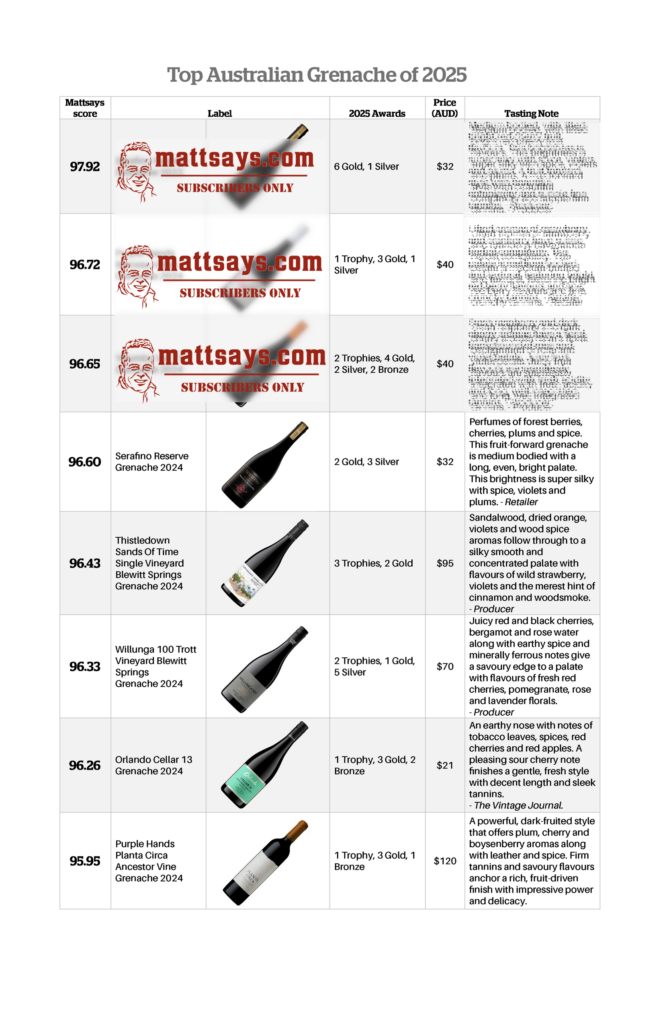
Our full list of Australia’s best best Grenache of 2025 is available exclusively on Substack. Subscribe for free to receive regular lists of Australia and New Zealand’s best wines:
You can find all our lists of Australia’s and New Zealand’s top wines here.